
Tool 2 · Decide

Restore or replace?

A coating is a new surface over a roof that is still doing its job. Whether this roof is a candidate is settled on the roof: our drone moisture scan maps the areas that look wet, with video from the flight and a written assessment, and cores confirm them. Answer four questions with what you know so far; the tool says where that leaves you, and the cost calculator sets the two ranges side by side.
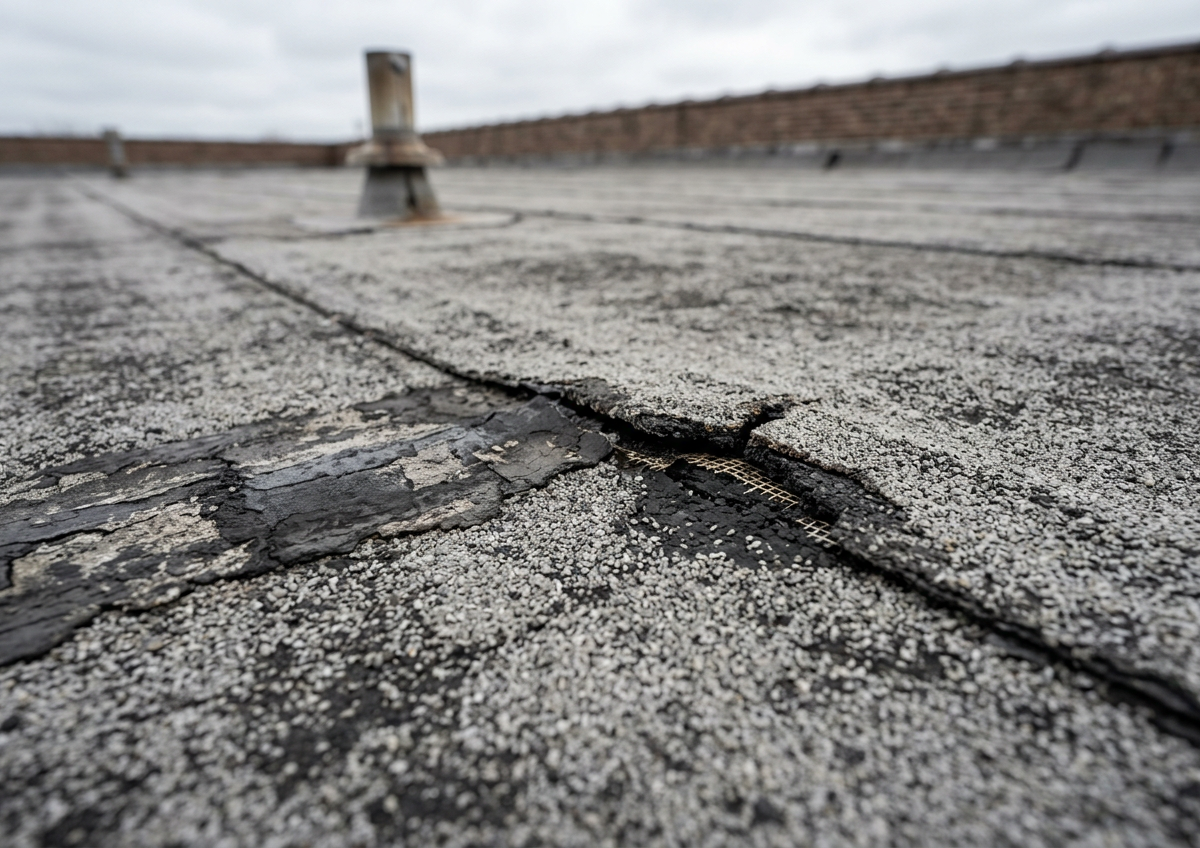
Low view along a weathered gray granulated flat roof: a lap seam split open with the reinforcement mesh showing, a cracked black patch beside it, a pipe vent and brick parapet beyond

Four questions

What do you know about the roof so far?

Answer for the roof level you are pricing. If there are several levels, run it once per level: they get different substrates and sometimes different answers.

  1. 1 How is the deck?

    The deck has to carry the crew, the equipment and the finished system.

  2. 2 What did the cores and the moisture scan find?

    A coating cannot dry insulation that is already wet.

  3. 3 How is the membrane?
  4. 4 How does it drain?

Answer the four questions and the answer appears here.

This is a structural question before it is a roofing one

A deck that is rusted through, rotted or moving is a question for the building's engineer, and no coating answers it. Nothing here is structural advice. Get the engineer's finding first; if the deck can be repaired to sound, run the tool again with the rest of the survey.

What makes a roof a candidate

Wet insulation across that much of the roof is replacement territory

Cutting out and replacing a few wet areas is routine. Manufacturers commonly draw the line somewhere between 15% and 30% of the roof, a rule of thumb rather than a code or a standard; past it, cut-and-replace stops being a repair line and becomes a replacement, and the arithmetic turns over with it. Confirm the scan with cores; if the wet area is smaller than it looked, run the tool again.

Run the numbers

Not a candidate as it stands

Splits through the field, laps open along their length, a cap sheet worn to the mat or foam that crumbles is a membrane that has failed, and a coating over it hides the failure rather than fixing it. This roof is a re-cover or a replacement conversation with your contractor.

What rules a roof out

Reattach the field before anyone quotes a coating

A field that has come loose from the substrate is a different job from a weathered one. The contractor decides whether the membrane can be re-secured; once it is attached and the laps are repaired, the roof is back on the candidate list. Run the tool again after that scope is written.

How to find out

Survey it before anyone quotes a system

Two of the four answers are still unknown, and they are the two that decide most jobs. We arrange a drone moisture scan, and you get a map with the areas that look wet outlined and measured in square feet, video from the flight and a written assessment. Core cuts at the flagged areas confirm them and show the deck; so does a look from below. Patch each core the day it is cut. On ballast or heavy gravel, metal panels, spray foam or a white-coated surface a thermal scan is the wrong tool; we say so, and the survey is done another way. Then run the tool again.

Request a moisture scan

Check the deck, then carry on

The insulation and the membrane look like a candidate, but the deck has not been checked. A look from below, or the core cuts, settles it. If it is sound, set the deck answer to Sound and the tool answers for the rest of the roof; if it moves or is corroded, it goes to the engineer.

What makes a roof a candidate

Run the moisture scan before the count

The deck and the membrane look like a candidate, but nobody knows yet whether the insulation is wet, and that is the question that decides most jobs. We arrange a drone moisture scan: you get a map with the areas that look wet outlined and measured in square feet, video from the flight and a written assessment. The scan marks suspects; the cores confirm them, and the square footage coming out and going back becomes a line on the quote. On ballast or heavy gravel, metal panels, spray foam or a white-coated surface a thermal scan is the wrong tool; we say so, and the survey is done another way.

Request a moisture scan

Find the cause of the standing water first

Water standing across the field after every rain is a different conversation from a low spot. Where the cause is deflection it belongs to the engineer. Where the roof simply never had slope, a coating does not add it: silicone resists standing water but does not fix drainage, and its specifications still expect at least 1/4 in per ft of slope and working drains. If it turns out to be a few low areas, they can be built up and the roof is a candidate, with silicone or the solvent-based elastomeric on top rather than a water-based acrylic.

Drainage that works, or can be made to work

A candidate, with repair lines before the coating

The wet areas get cut back to sound material, the insulation replaced to matching thickness and the patch tied back into the field. The low areas get built up so water leaves at the drains. Both go on the quote as their own lines, and the system then goes over a sound, dry roof.

Find the system for your roof

A candidate once the wet areas come out

A few wet areas are cut out and replaced before any coating goes down; laid over them, a coating seals the water in and the wet spot spreads under a surface that looks finished. Count the square footage coming out and going back for the quote, then the roof is a normal candidate.

Find the system for your roof

A candidate, with the low areas built up first

Low spots at drains, in valleys, along parapets and behind rooftop equipment get built up before the system goes on, so water leaves the roof instead of sitting on it. Where some ponding will remain, the coating is silicone, with no base coat under it, or the solvent-based elastomeric over its own base coat, rather than a water-based acrylic.

Find the system for your roof

A normal candidate

A sound deck, dry insulation, a weathered membrane with repairs at the laps and drainage that works is the roof a restoration system was made for. The next decisions are the primer for the substrate, the detail materials for the seams and penetrations, and the coats: a base and an acrylic finish, or Silicone44 with no base coat. The system finder walks them in order. Where a system warranty is wanted, the manufacturer inspects the finished roof before it issues one.

Find the system for your roof

What the tool is, and is not

The tool sorts what is known about the roof the way the guide does. It does not see the roof, and it is not structural advice. For the insulation, what is known starts with our drone moisture scan: a map with the areas that look wet outlined and measured in square feet, video from the flight and a written assessment. The scan marks suspects; the cores confirm them. On ballast or heavy gravel, metal panels, spray foam or a highly reflective or white-coated surface a thermal scan is the wrong tool, and the scan-fit tool names the survey that works instead.

What it typically costs

Restoring a low-slope roof with a coating system typically runs $3.50 to $7 per square foot installed; tearing it off and replacing it typically runs $10 to $18. Those are typical installed ranges drawn from published industry figures, not a quote: the roof’s condition, how much wet insulation has to come out, access and region move the number. Acrylic systems sit toward the low end of the restore range and silicone toward the high end. Applied over a sound, dry roof, a restoration system adds 10 to 15 years of service life. With the wet area known, the cost calculator sets both ranges against your roof and turns the restore range into a cost per year of added service. Run the numbers for your roof’s area.

Who decides

  • The contractor writes the scope. No contractor yet? We work with a network of installers, roofing contractors who apply these systems, and can introduce you to one anywhere in the US, who looks at the roof and says whether it is a good candidate for restoration.
  • The building’s engineer decides anything structural.
  • The local building department decides whether another layer is permitted at the address.
  • Sherwin-Williams offers UNIGUARD system warranties of 10 or 15 years when one of its authorized contractors applies the system, and inspects the finished roof before it issues one. The warranty is the manufacturer’s, issued under its own terms; we supply the materials.

Scan the roof first, then price the job

Owners: send the building's address and we quote the moisture scan for your roof; nothing has to be decided until you have seen the map. Already surveyed: send the area, substrate, wet area, seam feet and counts, and a person replies within one business day with the price, freight and a ship date.