
Restoration systems by roof type
Primer to finish coat, roof by roof
The finish coat is the last decision, not the first. What the roof is made of decides the preparation and the primer; how it drains decides between an acrylic system and Silicone44, which takes no base coat. Below is the build-up for each roof type by Sherwin-Williams part number: genuine Uniflex in sealed packaging, in stock by the pail, drum and tote, shipped in 1–3 business days.
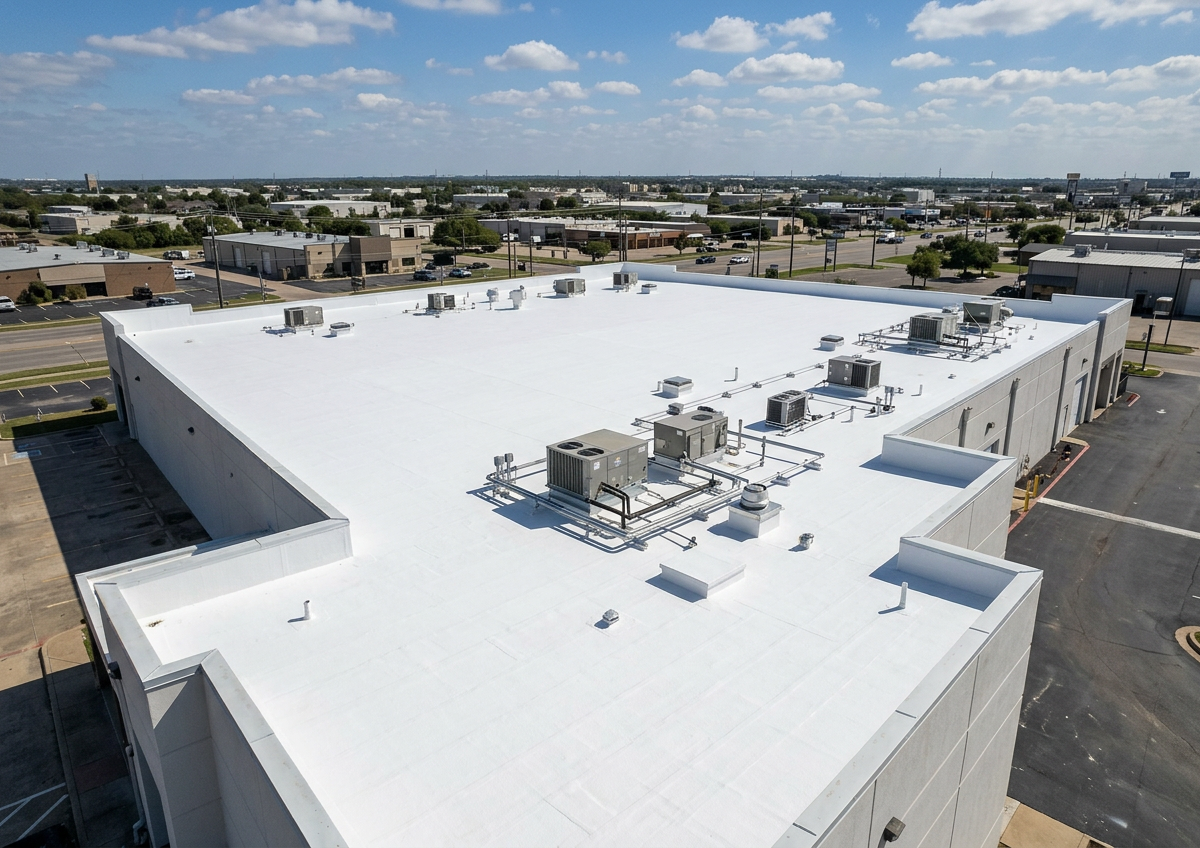
Primer, details, base coat, finish coat
The build-ups at a glance
Each row runs in the order the work goes on, over a sound, dry roof: coating makers, Sherwin-Williams included, require wet insulation to be found and replaced first. The acrylic build-ups come first, then Silicone44 for where water stands. Scan the roof before you budget.
| Metal, acrylic | KST034520 on corroded steel or KST036520 on pre-finished panels → seam tape KST020804, sealant KST058300, patching cement KST041220 → KST041320 → KST041300 |
|---|---|
| EPDM, acrylic | Wash primer KST038620, rinsed off → bonding tape KST058006, black sealant KST058310 → single-ply base coat KST041321 → KST041300 |
| TPO, PVC and Hypalon, acrylic | Pressure wash, no primer → KST058006 tape and KST058310 sealant on TPO and PVC, butyl seam tape KST020804 on Hypalon → base coat KST041321 → KST041300 |
| Modified bitumen, smooth built-up, cap sheet, acrylic | No primer: the MB base coat is the first coat (emulsion KST040312 where dried out) → fabric KST20385B, roof cement KST058600, KST0SLPBD at low spots → KST041510 → KST041300 |
| Spray foam, acrylic | No primer on sound foam → patching cement KST041220 → KST041520 → KST041300 |
| Concrete, acrylic | KST036500 → fabric KST20385A, patching cement KST041220, sealant KST058300 → KST041320 → KST041300 |
| Metal, Silicone44 | Fasteners tight, laps over 1/8 in fastened → KST034520 on every rusted area → laps striped with Silicone44 → Silicone44 KST044300 (white) or KST044320 (gray). No base coat |
| EPDM, Silicone44 | Wash primer KST038620, rinsed and dried → sealant KST058310 at open seams and flashings → Silicone44 KST044300 (white) or KST044320 (gray). No base coat |
| TPO and PVC, Silicone44 | Wash, adhesion test → KST058310 at open seams of aged membrane → Silicone44 KST044300 (white) or KST044320 (gray) direct. No primer, no base coat |
| Mod bit, smooth built-up, cap sheet, Silicone44 | Bleed Blocker Primer where the asphalt is newer (not stocked: ask us) → KST058310 at seams and flashings → Silicone44 KST044300 (white) or KST044320 (gray). No base coat |
| Spray foam and concrete, Silicone44 | Silicone44 KST044300 (white) or KST044320 (gray) straight onto sound foam or clean, cured concrete after an adhesion test. No primer, no base coat |
| Hypalon that holds water | No Uniflex silicone document covers Hypalon: send us the roof, and Uniflex names the primer in writing after an adhesion test |
| Solvent-based, where water stands | Base coat KST042200 under finish coat KST042100, on metal, foam and asphaltic roofs only; ships as regulated freight |
| Aluminum: metal, BUR, mod bit, cap sheet | Pressure-washed, fully dry roof, no primer named → fabric KST20385A (seam tape KST020804 on metal) → KST020475, KST020480 or non-fibered KST020418. No base coat |
Metal roofs
On metal, the rust decides the primer
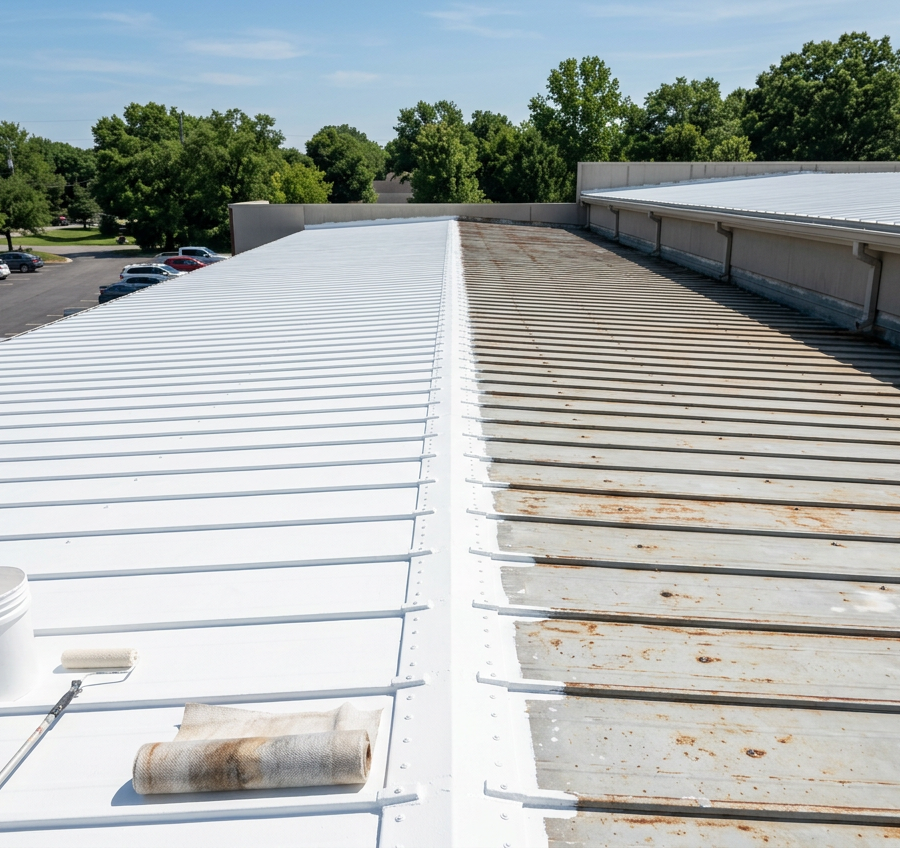
Corroded iron and steel take the rust-inhibitive primer under either system. Under an acrylic system, pre-finished panels take the acrylic metal primer listed for them. Under Silicone44 there is no base coat: every rusted area is primed, the laps are striped with the silicone itself, and on pre-finished (Kynar) panels an adhesion test decides whether any primer is needed. Either way, fasteners are tightened or replaced and the rust treated first, then every lap, rib and fastener head is detailed before the field is coated.
EPDM, TPO, PVC and Hypalon
On single-ply, the membrane sets the preparation
Weathered EPDM takes the Bond-It wash primer, rinsed off before anything else goes on; TPO, PVC and Hypalon are pressure-washed and take none. Under an acrylic finish, the single-ply base coat goes over all four and must be topcoated. Silicone44 goes on EPDM, TPO and PVC with no base coat, once an adhesion test passes: PVC is coatable, and Uniflex's single-ply specifications cover it. No Uniflex silicone document covers Hypalon, so a Hypalon roof that holds water comes to us first.
- The membrane is still attached, and the splits are at laps and details, not running through the field
- The insulation is dry. A roof with wet insulation is not a candidate until that is cut out and replaced
- The scan marks suspects; the cores confirm them. Nothing has to be decided until you have seen the map
Modified bitumen and built-up
On asphaltic roofs, the first coat blocks the bleed
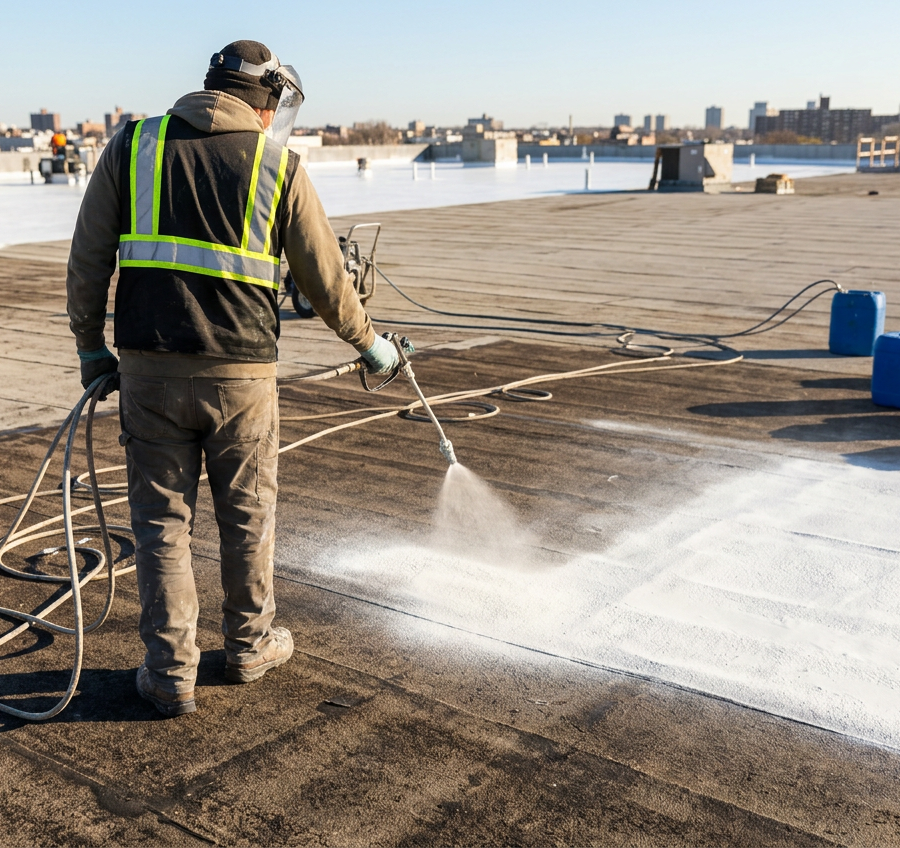
Under an acrylic finish, the MB base coat is the first coat on modified bitumen, smooth built-up and granulated cap sheet, and skipping it is how asphalt stains through a white finish. Under Silicone44 there is no base coat: where the asphalt is newer or likely to bleed through, Uniflex's Bleed Blocker Primer goes first, and we do not stock it, so ask on the quote form. For the acrylic system, a badly dried-out or alligatored surface is resurfaced with asphalt emulsion and fabric, and low spots are built up, before anything is coated.
Sprayed polyurethane foam
On foam, the coating goes straight on
Sound foam takes no primer: the acrylic base coat, or Silicone44 with no base coat at all, goes straight onto the clean foam. So what decides the job is the foam's condition: damaged or wet foam is cut out and replaced before anything is coated. A thermal scan is the wrong tool on closed-cell foam, so a foam roof is surveyed another way, with cores and a walk-through.
- Sound foam: it does not crumble under a screwdriver, and it is still bonded to what it was sprayed onto
- Dry foam: where water got in, that foam is cut out and replaced before any coating goes on
- Damage you can repair one place at a time: sun-worn foam, gouges, splits, pecked holes, blisters
Concrete roof decks
On concrete, the cracks set the detail work
Under an acrylic system, concrete takes the acrylic concrete primer, listed for surfaces with a pH of 6 to 13, then the same base and finish coats as metal. Silicone44 goes straight onto clean, cured concrete with no primer and no base coat; Uniflex asks for concrete cured at least 29 days, moisture of 15% or less, and sealers and release compounds removed. Either way the detail work is what differs: cracks and joints are closed and reinforced with polyester fabric before the field is coated.
- Structurally sound: deep spalls, deflection or a deck that moves are the building's engineer's call
- Cracks, joints and small holes that can be repaired one by one before anything is coated
- Penetrations, curbs and drains that can be resealed and detailed, counted at the survey, not mid-job
Where water stands
Where water stands, change the finish
Acrylic is the finish for a roof that drains; under prolonged ponding it can lose adhesion and peel. Silicone44 is the Uniflex coating made for areas where water stands, but it does not fix drainage: Uniflex's silicone specifications still expect at least 1/4 in per ft of slope and working drains, and water that stands for long means more inspection, cleaning and recoating over the years. Fix what can be fixed first; even the silicone's own data sheet says to remove ponding, because standing water adds load to the deck.
- Silicone44 KST044300 (white) or KST044320 (gray), with no acrylic base coat under it on any roof; the primer, where there is one, follows the roof type above
- Slope Builder KST0SLPBD, a powder mixed with water on site, is Uniflex's low-area build-up; no silicone specification names it under Silicone44, so there the adhesion test and Uniflex decide
- Hypalon that holds water: no Uniflex silicone document covers it, so send us the roof
- Solvent-based pair KST042200 and KST042100: metal, foam and asphaltic roofs only; ships as regulated freight
- Whether the deck carries standing water is a structural question for the building's engineer
Before you order
What settles a specification
This page and the system finder narrow the choice; three things settle it, in this order. If a system warranty is wanted, say so at quote time and the material list follows that specification.
-
The current data sheet
It names the primer, the preparation, the rate and the cure for each product in the system. A written specification wins over any list on this page, the system finder included.
-
The adhesion test patch
The system laid on a small area of the roof, cured, then pulled. For Silicone44, Uniflex's test embeds a fabric strip, waits three days and looks for at least 2 lb per inch; a lower result goes to Uniflex, which decides the primer. Nothing else tells you whether it holds on this roof.
-
Sherwin-Williams, where a warranty is wanted
Sherwin-Williams offers UNIGUARD system warranties of 10 or 15 years when one of its authorized contractors applies the system. The warranty is the manufacturer's, issued under its own terms; we supply the materials. The finished roof is inspected before one is issued.
Questions
Before you order the system
Which finish coat should I use?
Do I always need a primer?
Can I coat over an old coating?
What about gravel-surfaced built-up roofs?
How much material do I need?
Who applies the system?
Guides
Read before you specify
The reasoning behind the table: which system goes over which roof, silicone or acrylic, primers by substrate, and the seams, fasteners and flashings where a restored roof is won or lost.
- Which coating system goes over which roof
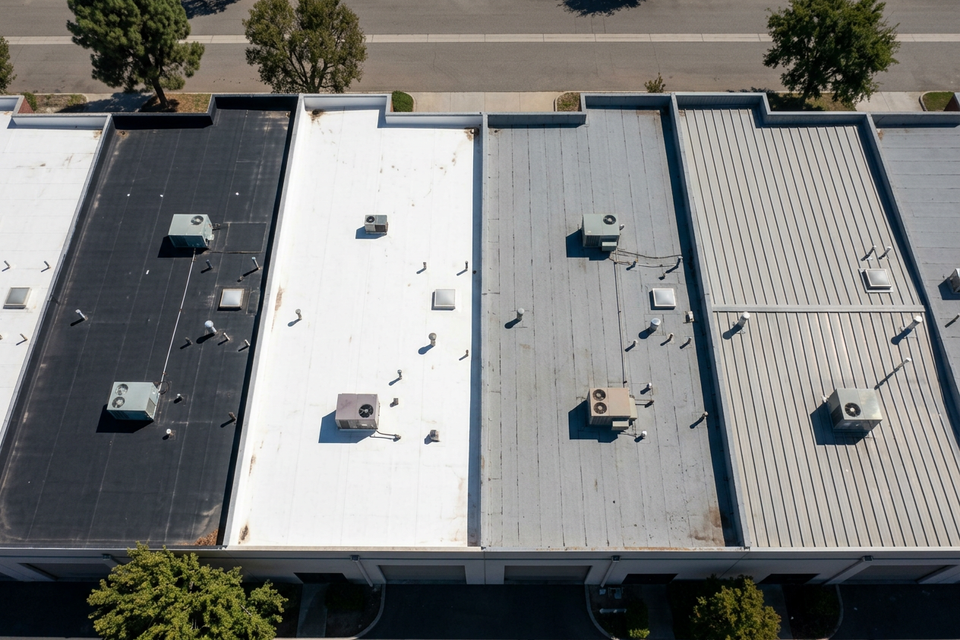
The acrylic and the silicone build-up for each roof: metal, EPDM, TPO, PVC, Hypalon, BUR, cap sheet, foam and concrete, with the part numbers.
- Silicone vs acrylic roof coatings: let the drainage decide
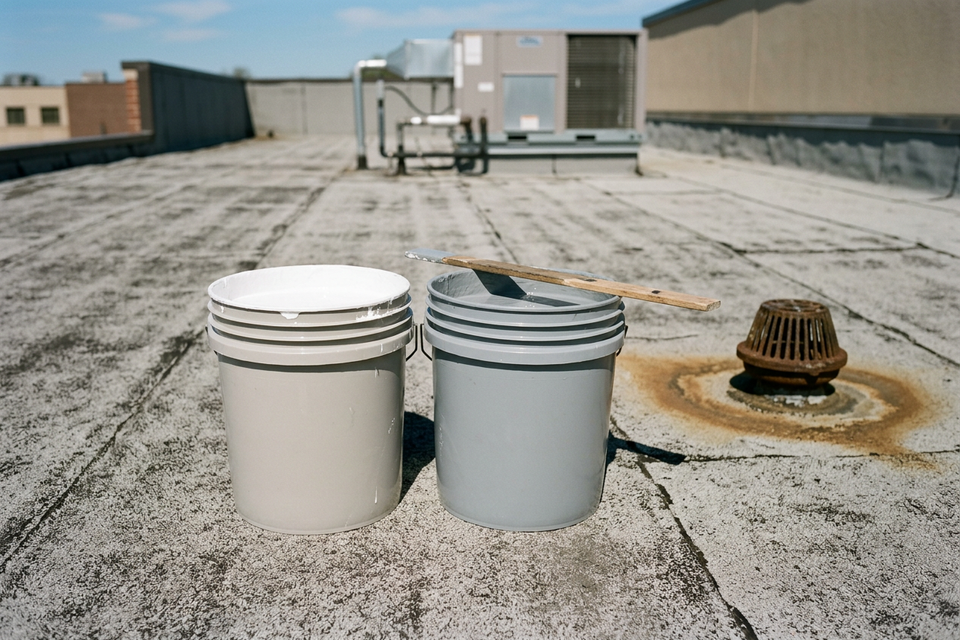
Acrylic where the roof drains, silicone where water stands: a side-by-side on ponding, sun, dirt, film build, recoating and cost, and what each commits you to.
- Primers under roof coatings: what each substrate needs
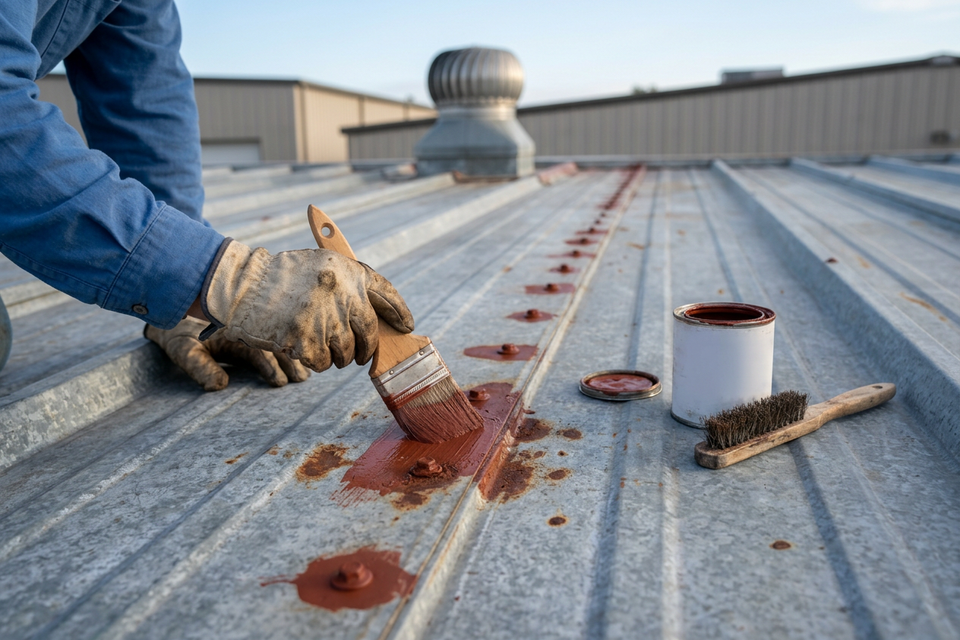
Whether a roof coating needs a primer depends on the substrate. Here is what metal, single-ply, asphaltic, concrete and foam roofs take, and what settles it.
- Seams, fasteners and flashings: where restoration is won or lost
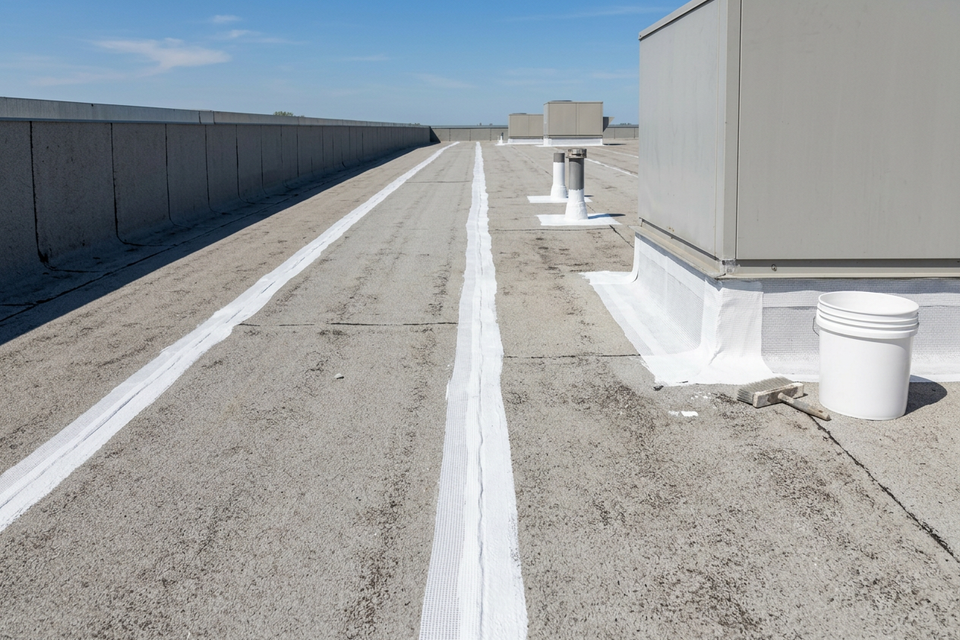
Reinforce every seam, fastener row and flashing before the field coats: butyl tape on metal, bonding tape on single-ply, fabric on asphaltic roofs.
Send the roof, get the material list
Tell us the substrate, the area of each roof level, the detail lengths and whether water stands anywhere. We count the system from the data-sheet rates and reply with the price, the freight and a ship date.
We reply within one business day.