
Tool 4 · Specify

Which system for this roof

A fluid-applied system is the preparation and primer the substrate calls for, a detail course over every seam and penetration, then the coats: an acrylic base and finish coat, or Silicone44 on its own where water stands. Three questions name the build-up for your roof with the Sherwin-Williams Uniflex product for each step.
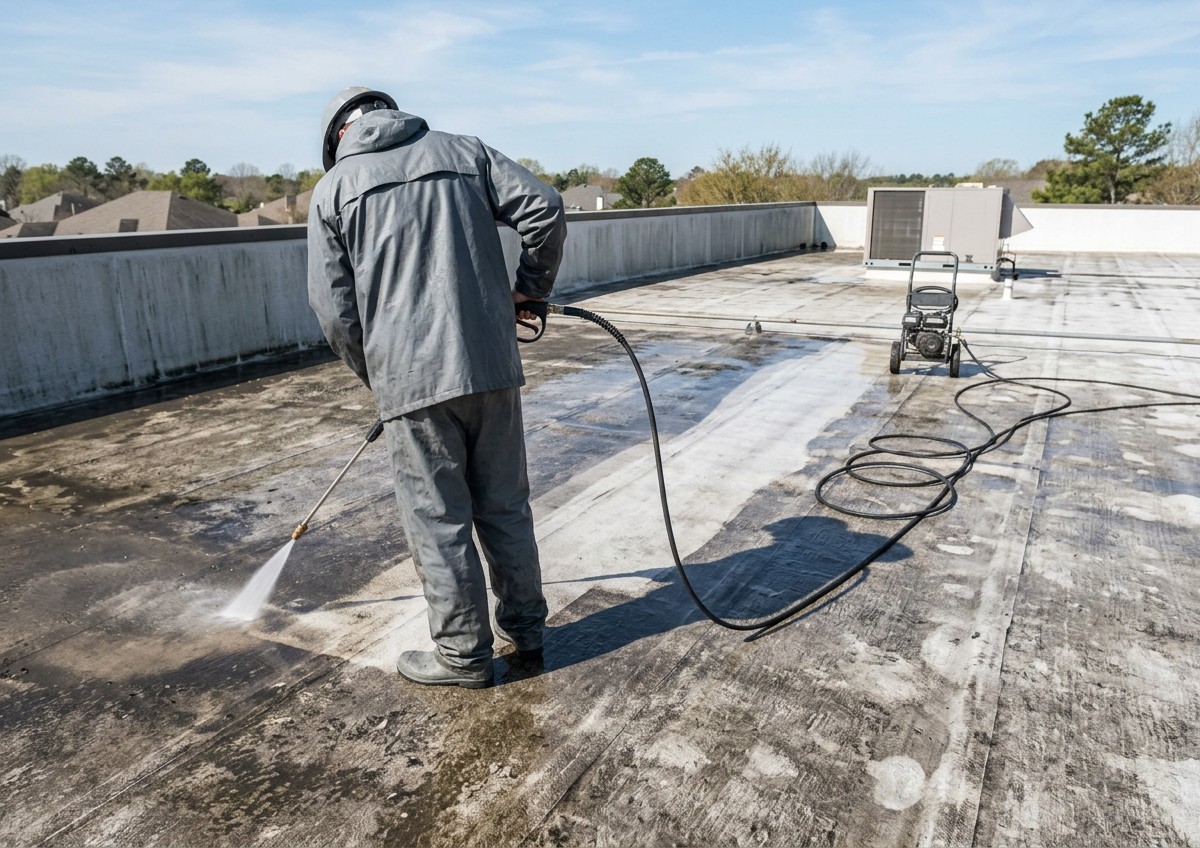
A worker seen from behind pressure-washing a grimy gray flat roof membrane, a paler cleaned lane behind the spray, the hose running back to a washer near a rooftop unit

Three questions

Describe the roof

The order of work is the same everywhere: clean, repair, prime where the substrate calls for it, detail everything that is not flat field, then the coats. The tool fills in the products for your roof by part number. For several levels or substrates, run it once per level.

  1. 1 What is the roof?

    The substrate decides the preparation and the primer.

  2. 2 Does the roof hold water?

    How it drains decides the chemistry on top.

  3. 3 What goes on top?

Answer the three questions and the build-up appears here, step by step.

Aluminum over metal

The 500 and 300 fibered aluminum coatings go directly over lightly rusted metal with no primer: pressure-wash off loose rust, dirt and chalk, let the roof dry completely, and coat at 50 °F or warmer with no rain forecast. Fasteners are tightened or replaced and seams and fastener rows detailed first. The Superbrite non-fibered coating lists metal too, but going directly over rust is stated for the fibered grades only. Heavier corrosion wants the rust-inhibitive primer and an elastomeric system instead. A written specification wins over this list.

Estimate the material

Aluminum on built-up, mod bit or cap sheet

The current data sheets for the 500 Premium, 300 Commercial and Superbrite aluminum coatings list smooth built-up, granulated asphalt and granulated or smooth modified bitumen. No primer is named: pressure-wash the roof, let it dry completely, and coat at 50 °F or warmer with no rain forecast. The black asphalt primer is a rejuvenator for dried-out smooth built-up and mod bit, not a required first step and not for granulated surfaces. Where water stands, silicone or the solvent-based elastomeric is the other answer. A written specification wins over this list.

Estimate the material

Aluminum is not the route on this roof

The aluminum coatings in this line list metal, smooth built-up, modified bitumen and granulated cap sheet. On EPDM, TPO, PVC, Hypalon, sprayed foam and concrete the system is an acrylic build-up for the substrate, or Silicone44 where the roof takes it. Choose the white elastomeric finish and run the tool again to see the build-up.

Which chemistry, and why

Metal that holds water: Silicone44

Wash the roof, tighten or replace fasteners and fasten any lap open more than 1/8 in. Prime every rusted area with the rust-inhibitive primer and let it cure. Stripe the end laps, fastened seams and ridge-cap laps with Silicone44, then coat the field with it; no acrylic base coat goes under it. On pre-finished (Kynar) panels an adhesion test decides whether any primer is needed, so send us the roof. Uniflex's silicone specifications detail curbs and penetrations with its OneFlash sealant, which we do not stock. Silicone44 does not fix drainage. The solvent-based pair is the other answer.

Estimate the material

Metal that drains

Fasteners get tightened or replaced and rust treated first; rust-inhibitive primer where corrosion is the problem, the acrylic white on pre-finished panels. Ribs, laps and fastener heads are detailed with tape, then the base coat and an acrylic elastomeric finish. For a tan or a matched color, the tans and tint bases are on the finish coats collection. The data sheet names the preparation, the rate and the cure; a written specification wins over this list.

Estimate the material

EPDM, TPO or PVC that holds water: Silicone44

Repair and wash the membrane. EPDM is cleaned with the Bond-It wash primer, rinsed and left to dry; weathered TPO and PVC take no primer. Seal open seams and flashings with the black MS hybrid sealant, then coat with Silicone44; no acrylic base coat goes under it. Run an adhesion test first: if it comes in low, or the membrane is new rather than weathered, Uniflex names the primer for that roof, so ask us. Uniflex's silicone specifications detail curbs and penetrations with its OneFlash sealant, which we do not stock. Silicone44 resists standing water but does not fix drainage.

Estimate the material

EPDM, TPO or PVC that drains

EPDM is cleaned with the wash primer, rinsed and left to dry; TPO and PVC are pressure-washed instead. Open seams and flashings are sealed with the black MS hybrid sealant, and laps, gutters and curbs closed with bonding tape. The single-ply base coat then covers the field and the details and is topcoated with an acrylic elastomeric finish. Uniflex's single-ply specification covers PVC too; on PVC the adhesion test settles the build-up. Keep the brushable repair sealant off EPDM. The data sheet names the preparation, the rate and the cure; a written specification wins over this list.

Estimate the material

Hypalon that holds water: send us the roof

No Uniflex silicone document covers Hypalon (CSPE), so the primer under Silicone44 has to come from Uniflex in writing, after an adhesion test on the roof. Send the roof, its area and where the water stands through the quote form and a person takes it from there. If the low spots can be corrected so the roof drains, the acrylic single-ply system is listed for Hypalon: answer that the roof drains to see it.

Send the roof for a quote

Hypalon that drains

Pressure-wash the membrane, then the single-ply acrylic base coat, whose data sheet lists Hypalon, topcoated with an acrylic elastomeric finish. The wash primer is for EPDM only and stays off Hypalon. At seams, flashings and penetrations the butyl seam tape is the listed detail, coated over with the elastomeric the same day. None of our cartridge sealants names Hypalon, and the TPO and PVC adhesion promoter is for those membranes only, so the cartridge sealant is confirmed with Uniflex's technical service and an adhesion test before the order: tell us the membrane type.

Send the roof for a quote

Built-up, mod bit or cap sheet that holds water

Repair and wash the roof. Where the asphalt is newer or likely to bleed through, Uniflex's Bleed Blocker Primer goes first; we do not stock it, so ask on the quote form. Seal seams and flashings with the black MS hybrid sealant, then coat with Silicone44; no MB base coat and no asphalt primer go under it. A granulated cap sheet takes more coating than a smooth surface. Uniflex's silicone specifications detail curbs and penetrations with its OneFlash sealant, which we do not stock. The solvent-based elastomeric over its own base coat is the other answer.

Estimate the material

Built-up, mod bit or cap sheet that drains

Asphaltic roofs get the elastomeric MB base coat, listed for smooth built-up, modified bitumen and granular cap sheets, then an acrylic elastomeric finish. An extremely dried-out or heavily alligatored roof gets resurfaced with asphalt emulsion first. A granular cap sheet takes more coating per square than a smooth membrane. The data sheet names the preparation, the rate and the cure; a written specification wins over this list.

Estimate the material

Sprayed foam that holds water

Wet or damaged foam is cut out and replaced first. Sound, clean foam takes Silicone44 directly, with no primer and no base coat, once an adhesion test passes. Foam has an orange-peel surface with real area in it; allow for it in the count. Silicone44 resists standing water but does not fix drainage: Uniflex's silicone specifications still expect at least 1/4 in per ft of slope and working drains. The solvent-based elastomeric over its own base coat is the other answer. The data sheet names the preparation, the rate and the cure; a written specification wins over this list.

Estimate the material

Sprayed foam that drains

Damaged or wet foam is cut out and replaced first. Sound foam takes the elastomeric base coat, both grades of which list polyurethane foam, then an acrylic elastomeric finish. Foam has an orange-peel surface with real area in it; allow for it in the count. The data sheet names the preparation, the rate and the cure; a written specification wins over this list.

Estimate the material

Concrete that holds water

Silicone44 goes directly onto clean, cured concrete, with no primer and no base coat. Uniflex asks for concrete cured at least 29 days, moisture of 15% or less, and sealers and release compounds removed. Wider cracks are reinforced with polyester fabric; Uniflex specifies its own sealant for the cracks, and OneFlash at curbs and penetrations, neither of which we stock, so ask us. Run an adhesion test first. The solvent-based pair does not list concrete, so it stays out of this build-up.

Estimate the material

Concrete that drains

Cured concrete gets the acrylic concrete primer, then a base coat and an acrylic elastomeric finish. Cracks are detailed with fabric and patching cement, or closed with a cartridge sealant where they move. The data sheet names the preparation, the rate and the cure; a written specification wins over this list.

Estimate the material

Send us the roof

That combination is one the guide does not settle on its own. Send the substrate, the area, how it drains and what you want on top through the quote form and a person names the system from the data sheets.

Send the roof for a quote

What settles the specification

Three things, in order: the current data sheet, which names the primer and the preparation; the adhesion test patch on the roof; and, where a system warranty is wanted, the manufacturer, which inspects the finished roof before it issues one. Sherwin-Williams offers UNIGUARD system warranties of 10 or 15 years when one of its authorized contractors applies the system. The warranty is the manufacturer’s, issued under its own terms; we supply the materials. Uniflex also requires a moisture survey by a qualified person on every system-warranty project, and a third-party survey for 15-year requests; whether a survey is accepted is Sherwin-Williams’ call.

Each roof type, in more depth

The tool gives the build-up; restoration systems by roof type gives the reasoning for each roof: what makes it a candidate, how it is surveyed, the layers drawn in order, and the finish where water stands.

Send the roof, get the price

The substrate, the area, the seam feet and the counts. A person names the system from the data sheets and sends the price, freight and a ship date.

We reply within one business day.