
Tool 1 · Survey
Will a thermal scan work on this roof?
Three questions about the roof, its surface and what is under the membrane say whether our drone moisture scan will work here, and if not, which survey does. It suits single-ply, mod bit and smooth built-up roofs over insulation board; gravel-surfaced built-up is a poor fit. It does not suit ballast or pavers, metal panels, spray foam, bare concrete, or a reflective or white-coated surface.
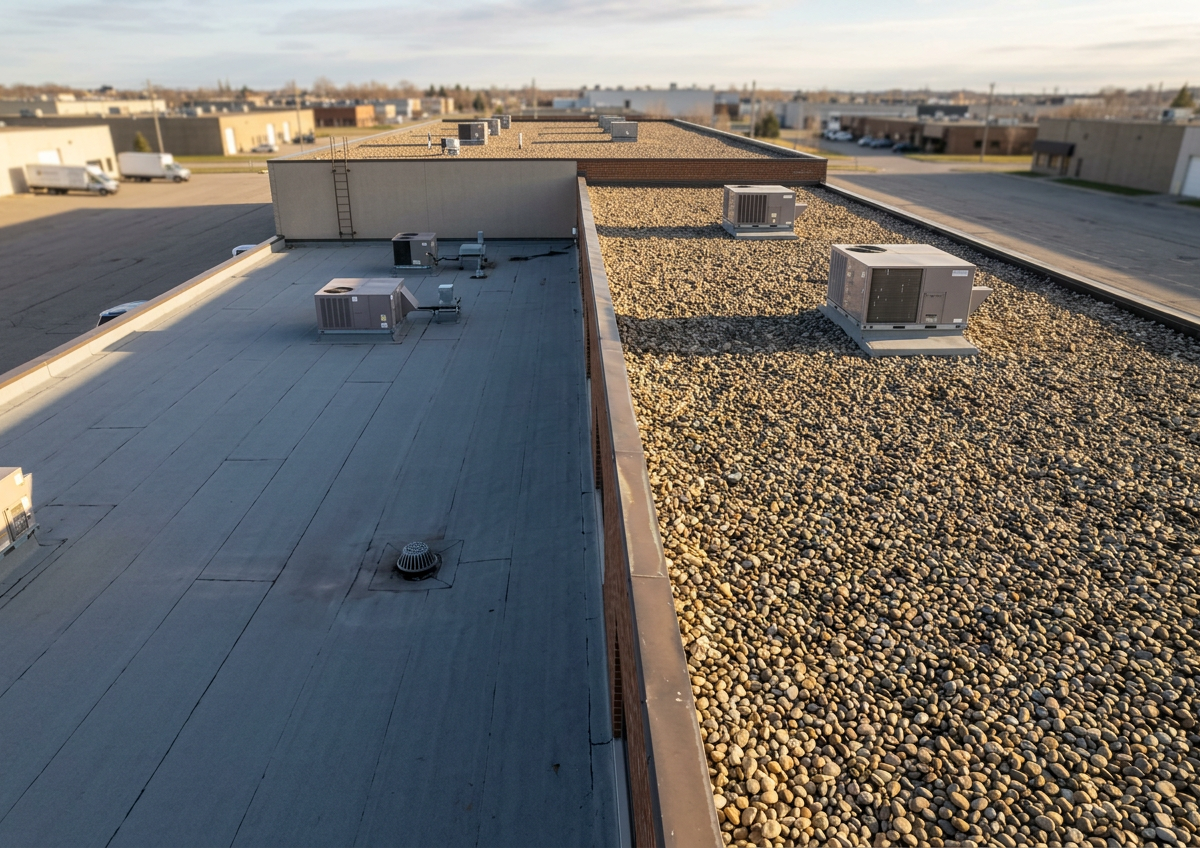
Three questions
Answer for the roof as it is today
One roof level at a time: a building with several levels can get a different answer for each. Not sure is a real answer here, and the result says what would settle it.
Why these three answers decide it
A thermal scan reads heat, not water. Through a sunny day the roof takes in the sun; after sunset, wet insulation under the membrane holds that heat longer than dry insulation, so it shows up warmer on the camera. Each question asks whether that can happen on this roof, and whether a camera can see it when it does. Infrared roof moisture surveys covers the method in full.
The roof type. The method is built for insulation laid above the deck, under the membrane; ASTM C1153, the standard practice for infrared roof moisture surveys, is written for that kind of roof.
- Single-ply, modified bitumen, smooth built-up: the roof the method was made for.
- Gravel-surfaced built-up: a poor fit; gravel throws warm patterns that can be impossible to tell from small wet areas.
- Ballast or pavers: not suited; they store the day’s heat and mask the differences the camera reads.
- Metal panels: not suited; reflections spoil the reading.
- Bare concrete: nothing to read; there is no insulation on top.
- Spray foam: little to find; closed-cell foam does not hold water the way board insulation does.
The surface. The method runs on the day’s sun. White finish coats reflect sunlight and keep the roof surface cooler, so less heat goes into the roof for the camera to read after sunset. An aluminum coating is made to reflect, and reflections spoil a thermal image. A white coating makes later thermal work harder, which is one more reason to scan before you coat rather than after.
What is under the membrane. The camera is looking for insulation that has taken up water. EPS foam board does not hold water the way perlite, wood fiber or glass fiber board does. Lightweight insulating concrete and poured gypsum hold moisture from when they were poured and from service, which makes a thermal survey difficult. With no insulation above the deck, there is none to find. Wet roof insulation explains why wet board comes out before any coating goes on.
What no answer changes
- A scan needs a sunny day followed by a clear, dry, calm evening.
- It shows temperature differences, not water: rooftop exhaust, ponded water and debris can read warm too.
- A camera overhead cannot see under rooftop units.
- The scan marks suspects; the cores confirm them. Capacitance and nuclear readings need cores too.
Coating makers, Sherwin-Williams included, require wet insulation to be found and replaced before a coating goes on. Whichever survey suits the roof, that is the job it does. Uniflex also requires a moisture survey, by a qualified person, on every Uniflex system-warranty project, and a third-party survey for a 15-year warranty request; whether a survey is accepted is Uniflex’s call, not ours.
Moisture survey methods compared sets infrared, capacitance, nuclear and cores side by side, and core samples explains how a finding gets confirmed. To see what a scan delivers, see a sample scan: a sample from a real scan, with the address, the people and the companies removed and the map re-oriented. The sample shows the map and the image pairs; a full scan also comes with video from the flight and a written assessment.
What the tool is, and is not
It sorts what you know about the roof. It is not a survey: the cores say what is wet, the contractor writes the scope, and the building’s engineer decides anything structural.
Send the address, and we will say what fits
Put the building's address in the message, with the roof type and anything you know about what is under it. We will tell you whether a thermal scan suits it or which survey does, and quote the scan for your roof if it fits. We arrange scans for commercial low-slope roofs anywhere in the US.