
Modified bitumen, smooth built-up, granulated cap sheet
Coat modified bitumen and built-up roofs in the right order
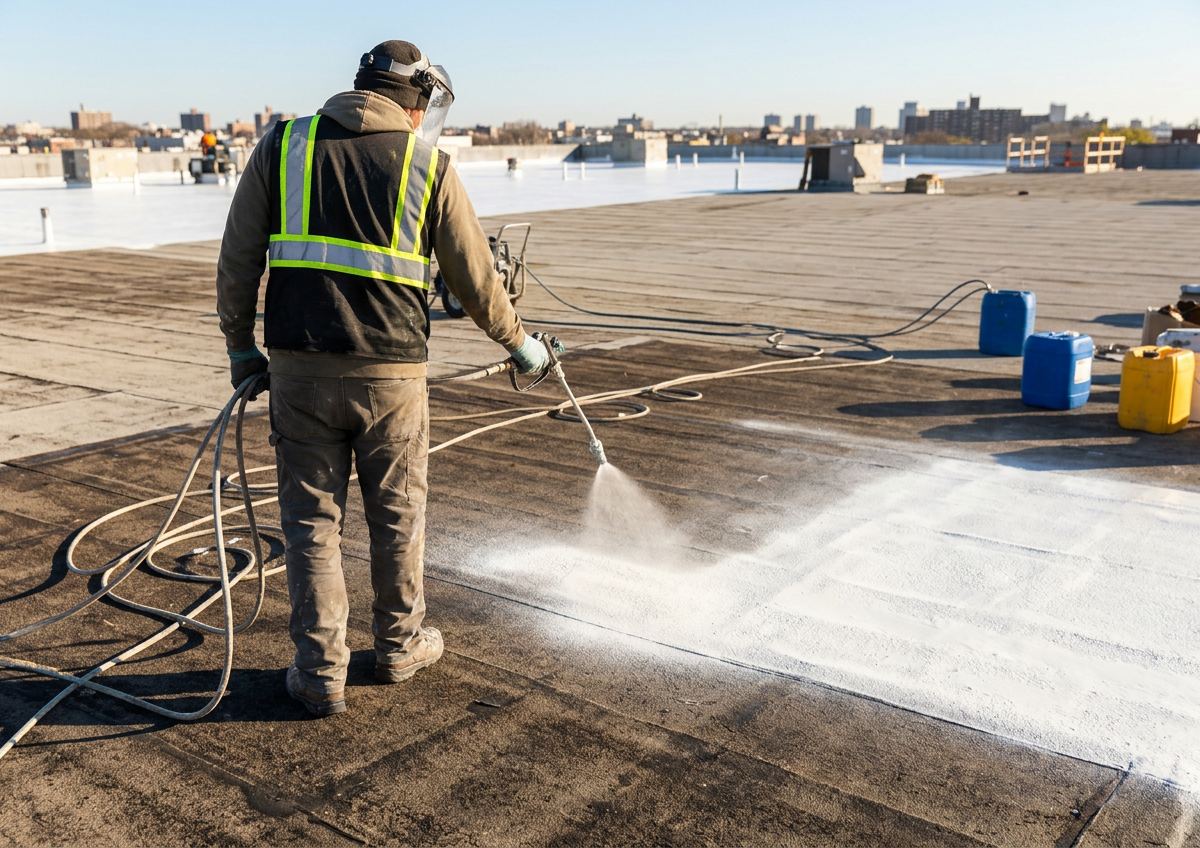
A mod bit, smooth built-up or cap sheet roof that is attached, largely intact and dry can be restored in place. Here is the Sherwin-Williams Uniflex system by part number: repairs, details, then the MB base coat under an acrylic finish, or Silicone44 with no base coat where water stands. Before you budget, our drone moisture scan gives you the map, video from the flight and a written assessment.
Is this roof a candidate
A weathered roof qualifies; a loose or soaked one does not
Asphaltic roofs age in familiar ways: granules shed, smooth surfaces dry out and alligator, blisters rise, laps split and flashings tear at curbs and parapets. Found in places, each is a repair line ahead of the coating. What rules a roof out is wider: a field come loose from what it sits on, splits running through the field rather than at the laps, a cap sheet worn down to the mat, or wet insulation over a large share of the roof. Applied over a sound, dry roof, a restoration system adds 10 to 15 years of service life.
- Attached: the field still fixed to what it sits on, not lifting or loose
- Largely intact: blisters, splits and open laps that can be repaired one by one
- Dry insulation: where no gravel or ballast covers the roof, a thermal scan maps what looks wet
- Wet areas cored to confirm, then cut out and replaced before anything is coated
- A sound deck: anything structural is the building engineer's call
- Drainage that works, or low spots that can be built up at drains, in valleys and along parapets
The build-up
What goes on, from the existing roof up
Read it from the bottom. The existing roof stays, less any wet areas cut out and replaced. Repairs and low spots come first, then an asphalt emulsion resurfacing, only where the surface is extremely dried out or heavily alligatored. The details are three-coursed in fabric, and the MB base coat goes across the whole field as the first coat, with no primer under it. The aluminum route swaps the base and finish coats for an aluminum coating; its data sheets list smooth built-up, mod bit and granulated cap sheet. Silicone44 takes neither the MB base coat nor the asphalt primer.
White system, on a roof that drains
- Finish coat KST041300 Or commercial grade KST041500
- MB base coat KST041510 The first coat across the field; no primer
- Fabric KST20385B Three-coursed at seams, laps and flashings
- Emulsion KST040312 Only where extremely dried out
- Slope Builder KST0SLPBD Low spots built up
- Roof cement KST058600 Repairs and core patches
- Existing mod bit, BUR or cap sheet Attached and largely intact
- Insulation and deck Dry: wet areas replaced first
Aluminum route: aluminum KST020475 in place of the base and finish coats, no base coat and no primer named
Silicone44 where water stands: Bleed Blocker Primer on newer asphalt (we do not stock it), then the silicone, with no MB base coat
Order of work
From the repairs to the finish coat
The white system on a roof that drains, in the order it goes on. The data sheet names the preparation, the rate and the cure for each product, a written specification wins over this list, and an adhesion test patch settles whether it holds on this roof.
-
Clean, cut out what is wet, repair
Wash the field and clear ponded silt and loose granules. Wet areas the cores confirm are cut out and replaced to matching thickness. Blisters, splits and open laps are repaired, and core cuts patched, with wet-dry roof cement KST058600, which takes a repair on an asphaltic roof wet or dry.
-
Build up the low spots
Slope Builder KST0SLPBD, a powder mixed with water on site, fills low areas at drains, in valleys and along parapets, and forms crickets behind rooftop equipment, before anything is coated. Where the water stands because the deck deflects, that is a question for the building's engineer.
-
Resurface a dried-out roof, only if it needs it
Where smooth built-up or mod bit is extremely dried out or heavily alligatored, fibered asphalt emulsion KST040312 resurfaces it, with fabric, so the coating has something whole to go on. It is a resurfacer, not a finish, and it cures before the next coat. A roof that is only weathered skips this.
-
Three-course the seams, laps and flashings
Every lap, seam, curb, pitch pan and flashing gets coating, polyester fabric KST20385B and coating again, before the field is coated. KST20385A, the narrower roll, suits the smaller details.
-
MB base coat: the first coat, no primer
Elastomeric MB base coat KST041510 white, or KST041512 gray, goes across the whole prepared field; a gray base under a white finish lets the crew see coverage. It is a base coat only and takes an elastomeric finish. Skipping it is how asphalt stains through a white finish.
-
Finish coat
Premium acrylic KST041300, or commercial-grade KST041500, over the base coat. On a granulated cap sheet the granules take more coating per square than a smooth surface, so count it as its own line on the order. Where water stands, the finish changes, as set out below.
By part number
The materials, in order
Cement, Slope Builder, emulsion, fabric, MB base coat and acrylic finish, then silicone for where water stands and fibered aluminum for the budget route. Genuine and sealed, in stock, shipped in 1–3 business days.
-
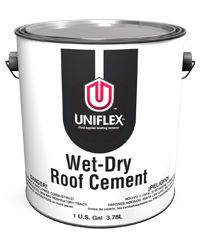
KST058600 Uniflex wet-dry roof cement
-
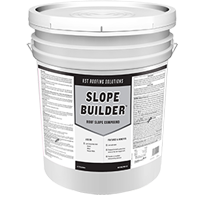
KST0SLPBD Uniflex Slope Builder compound
-
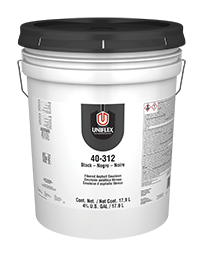
KST040312 Uniflex fibered asphalt emulsion roof coating
-
KST20385B Uniflex polyester reinforcing fabric · 12 in × 324 ft
-
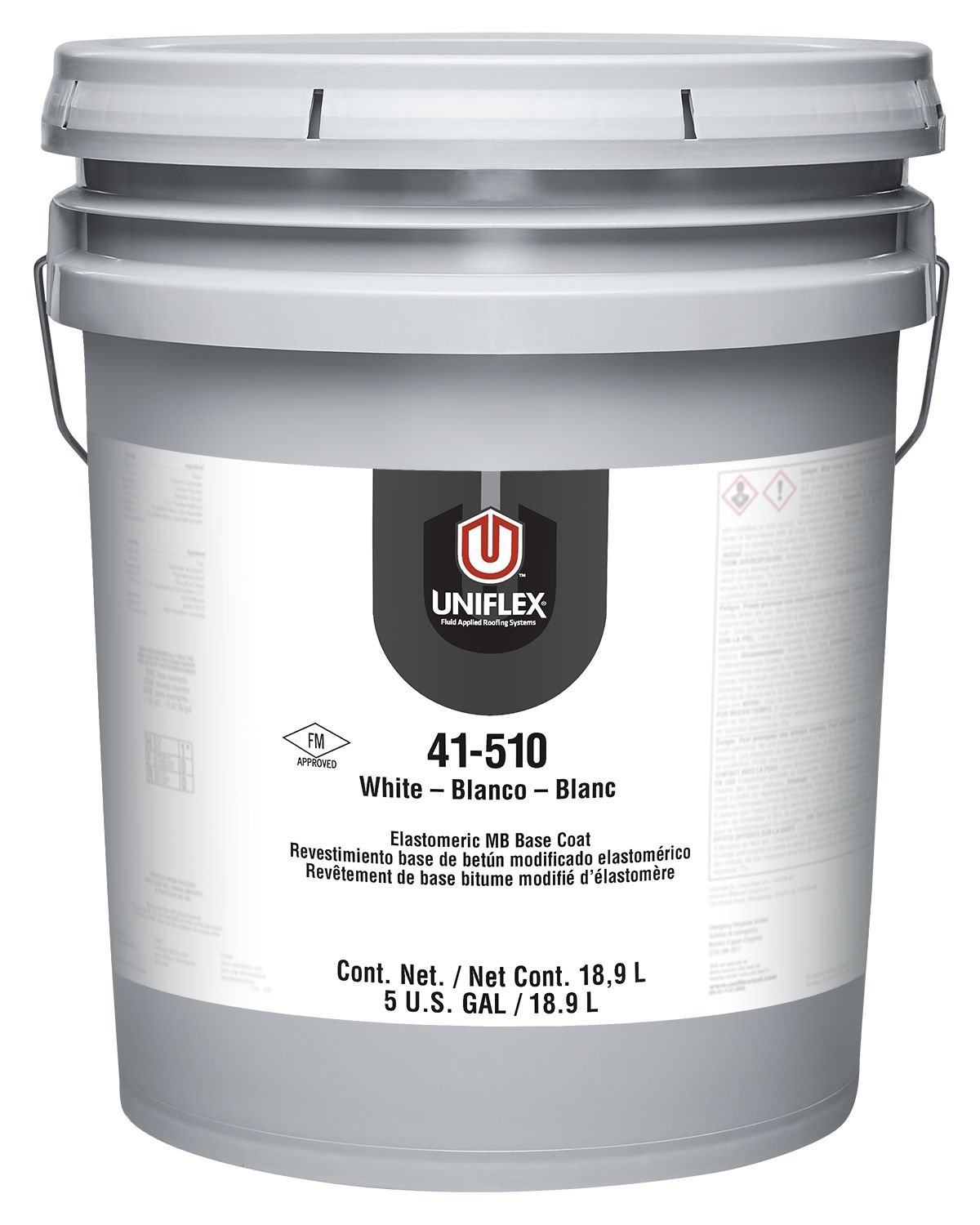
KST041510 Uniflex elastomeric MB base coat
-
KST041300 Uniflex premium acrylic elastomeric roof coating
-
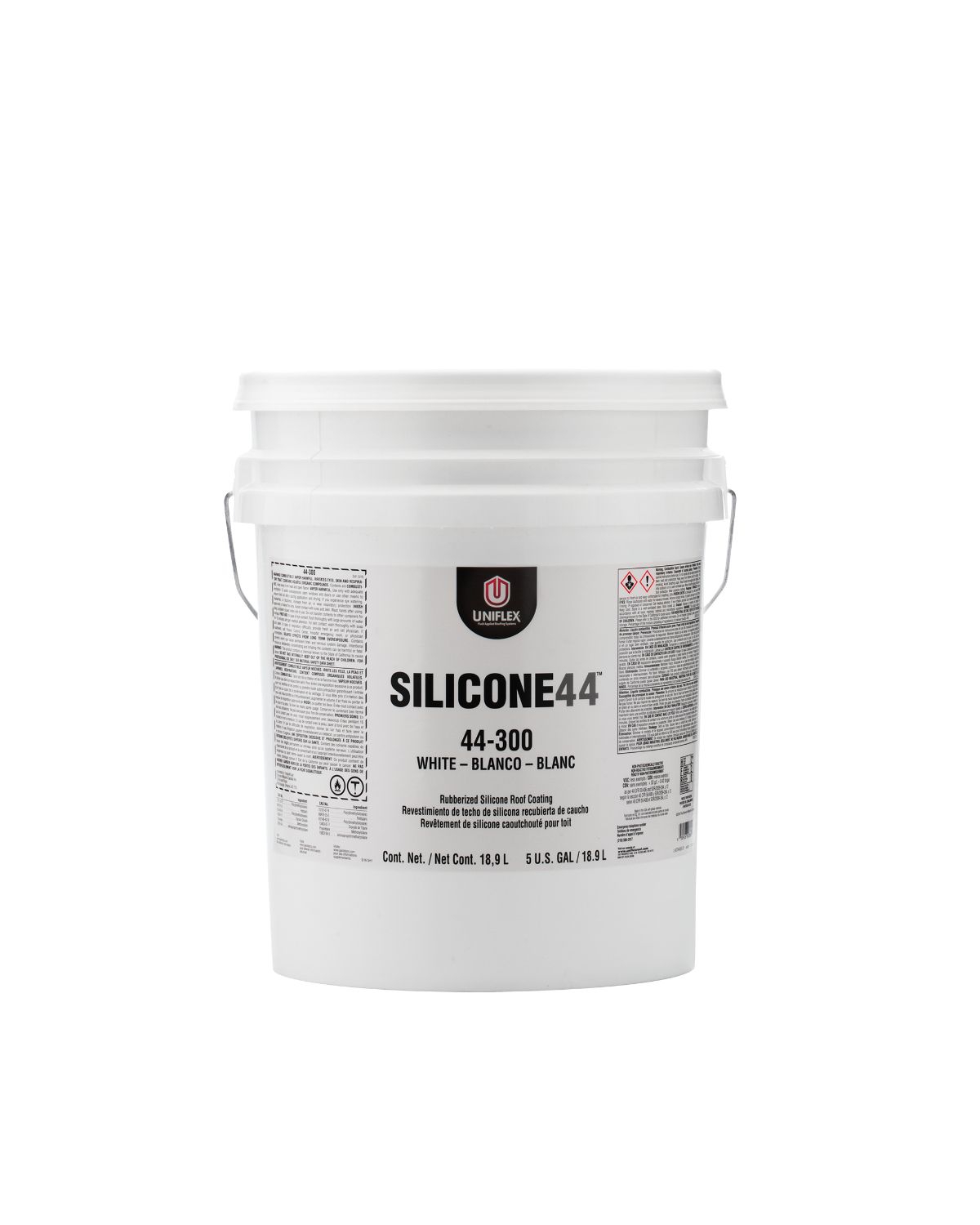
44-300 Uniflex Silicone44 rubberized silicone roof coating
-
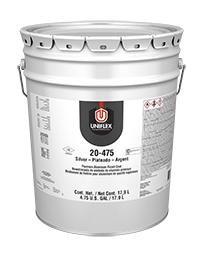
KST020475 Uniflex 500 premium fibered aluminum roof coating
Where water stands, and the budget route
Two things change the finish: water and budget
Acrylic is the finish for a roof that drains; under prolonged ponding it can lose adhesion and peel. Under Silicone44 there is no MB base coat: repair and wash the roof, put Uniflex's Bleed Blocker Primer down where the asphalt is newer or likely to bleed through (we do not stock it, so ask on the quote form), seal seams and flashings with the black MS hybrid sealant KST058310, then coat. Silicone44 does not fix drainage: Uniflex's silicone specifications still expect 1/4 in per ft of slope and working drains. Whether the deck can carry standing water is the building engineer's call.
- Where water stands: Silicone44 KST044300 (white) or KST044320 (gray), with no MB base coat and no asphalt primer under it; or solvent-based KST042200 under KST042100
- A granulated cap sheet takes more coating than a smooth surface, whichever finish goes on
- Budget route: aluminum KST020475, KST020480 or non-fibered KST020418, listed on smooth built-up, mod bit and granulated cap sheet alike, with no primer named
- Aluminum goes on a pressure-washed, fully dry roof at 50 °F or warmer, with no rain forecast
- Black asphalt primer KST020412: only to rejuvenate dried-out smooth built-up and mod bit; not for granulated surfaces
- The solvent-based pair, the asphalt primer and the aluminum coatings ship as regulated freight
Questions
Coating mod bit and built-up, asked plainly
Do I need a primer on modified bitumen?
Will asphalt stain through a white coating?
Can a gravel-surfaced built-up roof be coated?
Can aluminum go on a granulated cap sheet?
How much more material does a granulated cap sheet take?
Should the roof be scanned before it is coated?
Can a restored mod bit roof carry a manufacturer's warranty?
Who applies the system?
Price the system for this roof
Send the area of each roof level, the surface (mod bit, smooth built-up or cap sheet), the detail lengths and whether water stands. Building owners can start with the moisture scan; nothing has to be decided until the map is in.
We reply within one business day.