Wet mils, dry mils and coverage: the math behind a coating job
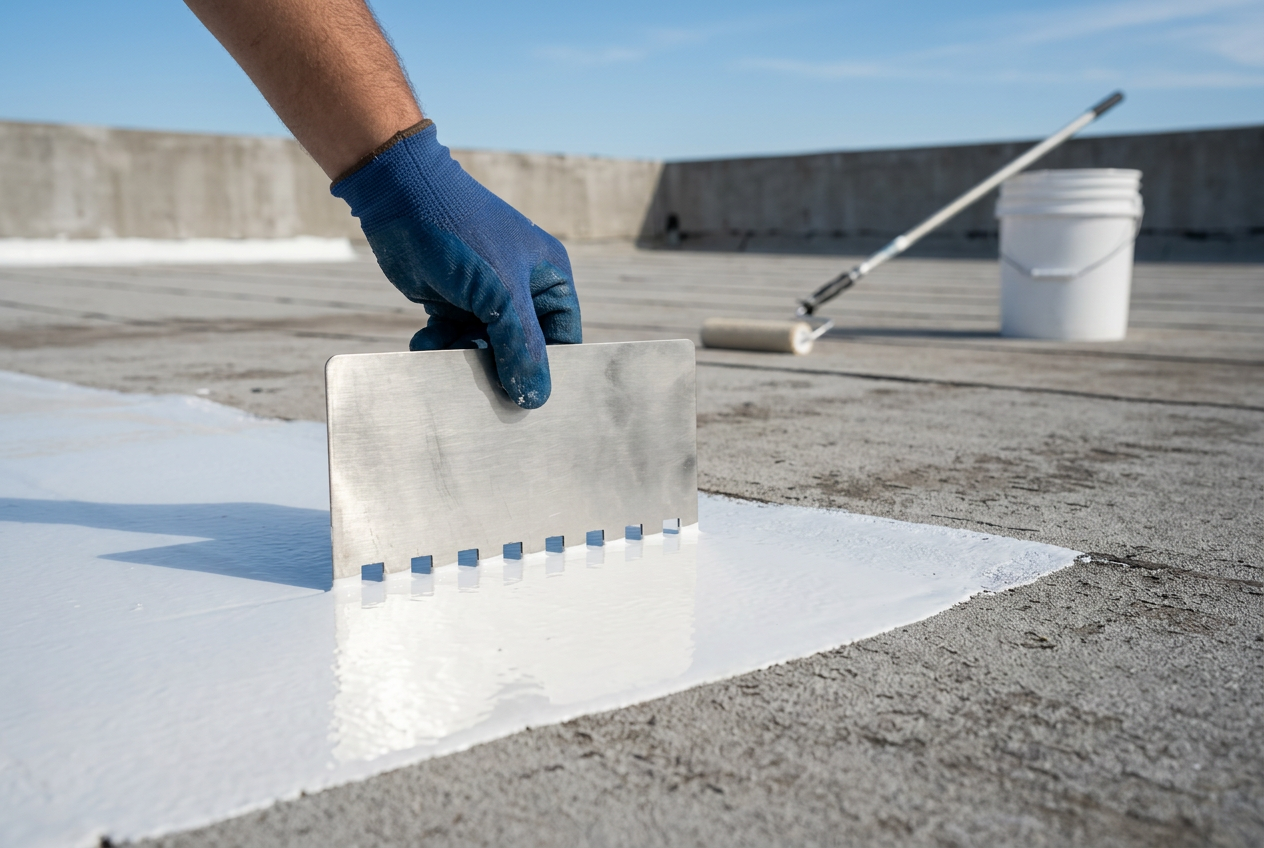
To turn wet mils into dry mils, multiply by the coating’s volume solids: a coat laid 20 mils wet from a coating that is, say, 60 percent solids by volume dries to 12 mils. The other number every estimate rests on is a constant: one gallon spread one mil thick covers 1,604 sq ft, so a gallon over 100 sq ft is about 16 wet mils.
Everything else here follows from those two, and none of it is a rate. The rate for your product on your substrate is printed on its data sheet, and the material estimator takes the figure you read there.
A mil, a wet film and a dry film
A mil is a thousandth of an inch, not a millimeter (a millimeter is about 39 mils).
Wet film is the coating’s thickness the moment it goes down, water or solvent included. Dry film is what is left once the carrier has gone. It is the roof’s new surface, the thing sun, rain and foot traffic wear at, and the figure a specification is written in.
Volume solids: what stays on the roof
A coating is a carrier, water or solvent, and the solids it carries. The carrier leaves; the solids stay. Volume solids is the share of the wet volume that stays, and it links the two films:
dry mils = wet mils × volume solids
Some data sheets print solids by weight as well as by volume. A film is a volume, so the volume figure is the one for this formula. If a sheet prints one figure without saying which, ask the manufacturer’s representative before you price on it.
One constant, two formulas
A US gallon is 231 cubic inches. Spread one mil thick, that volume covers 231,000 sq in, which is 1,604 sq ft.
Formula 1: square feet per gallon at a given dry film.
sq ft per gallon = 1,604 × volume solids ÷ dry mils wanted
Formula 2: gallons per 100 sq ft and wet mils are the same fact. Over one square (100 sq ft), a gallon is 1,604 ÷ 100 = 16.04 mils of wet film, so:
wet mils = gallons per 100 sq ft × 16.04
| Gallons per 100 sq ft | Wet mils |
|---|---|
| 0.5 | 8.0 |
| 1.0 | 16.0 |
| 1.5 | 24.1 |
| 2.0 | 32.1 |
| 2.5 | 40.1 |
| 3.0 | 48.1 |
Multiply any row by the volume solids and you have the dry film that rate leaves on a smooth surface.
Data sheets state coverage as gallons per 100 sq ft per coat, as square feet per gallon, or as the dry mils a stated rate leaves. That last figure is the volume solids restated as a film: divide it by the rate’s wet mils (16.04 for a gallon per 100 sq ft) and the sheet’s volume solids should come back, a quick check that its figures agree.
Two worked examples, with invented figures
The solids figures and the rate below are invented to show the arithmetic. They are not any product’s data and not a rate for any coating we sell; read the real figures off the data sheet for your system.
Example 1: from a dry film to gallons. A specification asks for 24 dry mils. Two coatings could deliver it, one 60 percent solids by volume, the other 75 percent.
| Step | 60 percent solids | 75 percent solids |
|---|---|---|
| Wet mils needed: 24 ÷ solids | 40 | 32 |
| Gallons per 100 sq ft: wet mils ÷ 16.04 | 2.5 | 2.0 |
| Coverage: 1,604 × solids ÷ 24 | 40 sq ft per gal | 50 sq ft per gal |
Same dry film, and the lower-solids coating takes half a gallon more on every square. A price per gallon says nothing until you know the solids and the film the price is built for.
Example 2: from a data-sheet rate to the dry film it leaves. A data sheet calls for 1.25 gallons per 100 sq ft per coat, two coats, and prints 60 percent volume solids.
- Each coat wet: 1.25 × 16.04 = about 20 wet mils.
- Each coat dry: 20 × 0.60 = 12 dry mils.
- Two coats: 24 dry mils, on a smooth surface with nothing lost.
That is the same 2.5 gallons per square as the 60 percent column above, split into two coats. If a specification asks for more dry film, the answer is more gallons, laid within what the data sheet allows per coat; spreading the same pails further only makes the film thinner.
Why the substrate changes the answer
The constant assumes a flat, smooth plane. Roofs are not.
- A granulated cap sheet takes the first coat down between the granules before any film builds on top.
- A weathered or alligatored asphaltic roof is rough and porous, and the first coat soaks in.
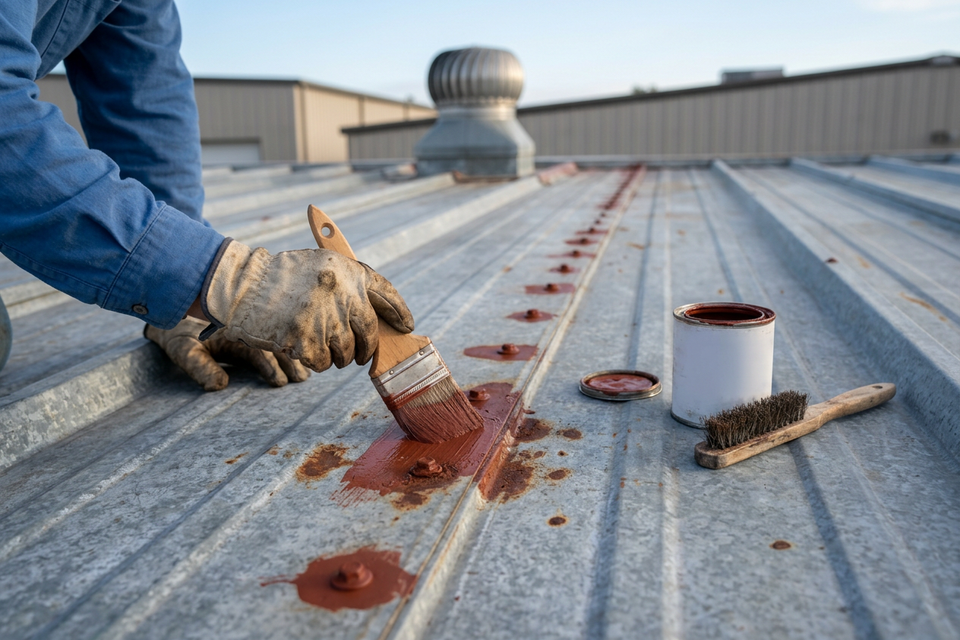
- Sprayed foam (orange-peel texture) and ribbed or corrugated metal have more surface than the plan area shows, and coating collects at the ribs.
On these the same gallons leave a thinner film than the arithmetic says. Data sheets usually give the rate as a range; take the higher end on a rough surface, above all for the first coat.
Then comes waste: what stays in the pail, fills the hose and pump, drifts off as overspray or is lost at the edges and details. That allowance sits on top of the rate, and the figure is the contractor’s own from past jobs; how to estimate material carries it through to pails and drums. A count that ignores texture and waste does not buy a cheaper job. It buys a thinner roof than the specification.
Checking as you go
Two checks keep the arithmetic honest while it can still be corrected.
A wet-film gauge. Press a notched gauge square into the fresh coat and lift it straight out. The last tooth that comes up wet and the first that comes up clean bracket the wet film at that spot; multiply by the volume solids for the dry film it will leave. Take readings early in each coat and across the whole area.
Pails against area. The rate predicts how far each container should go. At the invented 1.25 gallons per 100 sq ft above, a 5-gallon pail covers 400 sq ft and a 55-gallon drum 4,400. Count opened pails against the area done; it is the one check that covers the whole roof. A pail that stretched to 500 sq ft went down at a gallon a square: 16 wet mils instead of 20, and at 60 percent solids under 10 dry mils where 12 was intended. Caught on the first pails, that costs a few squares of rework; found at the end, it means more material across the whole field.
Dry film, warranties and the number of coats
Coating makers’ specifications commonly set the dry film by warranty term, with a thicker film for a longer term. The schedule is each manufacturer’s own, and we do not reprint one. Sherwin-Williams offers UNIGUARD system warranties of 10 or 15 years when one of its authorized contractors applies the system. The warranty is the manufacturer’s, issued under its own terms; we supply the materials. Roof coating warranties sets out what specifications ask for first.
Dry film is the measure because it is what is left after texture and waste take their share, and it is what weathers: a water-based acrylic chalks and loses thickness over time, so a thin film has less to give.
The coat count is the data sheet’s too: some sheets allow the full film in one coat or in two. Where a sheet names two coats, with a rate per coat and a time between them, two thin coats are not one thick one. The second covers the whole of the first, so a spot the first left thin gets another layer, and a single pass at twice the rate is a film the sheet does not describe. Follow the sheet’s coat count and check each coat wet; the system’s dry film is the sum of its coats.
Why roof coatings fail lists a thin film among the causes, and how long a roof coating lasts sets the film beside the other things that decide it.
Where the real numbers come from
- The product data sheet gives the volume solids, the rate per square per coat (often as a range), the number of coats and the time between them.
- The manufacturer’s specification sets the dry film by warranty term where a system warranty is wanted; where its representative wrote one for the roof, its figures are the ones to price.
- The contractor owns the texture and waste allowance, the gauge readings, the pail count, and means and methods.
- The adhesion test patch settles whether the system holds on this roof at all; no film thickness rescues a coating bonded to dirt.
- We supply the materials. The rate and the film are not ours to set.
Run the area and the data-sheet rates through the material estimator, then send the area by level, the substrate, the system and the detail counts through the quote form. A person counts the material, names what is not included, and replies within one business day with the price, freight to the site and a ship date.
Last updated 2026-10-05.